Novel experiment
The novel experiment contributes only short-term surrogates, such as clicks, sessions, conversion proxies, or early retention markers.
Application Layer
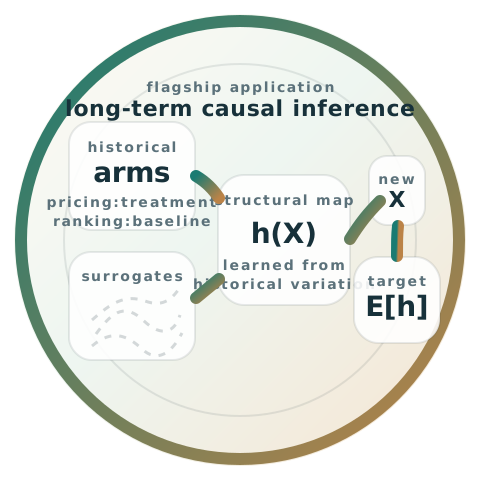
The goal is to learn a surrogate-based index for long-term outcomes that remains valid under surrogate-outcome confounding. Rather than regressing long-term outcomes directly on surrogates, the package uses historical experiment arms as instruments to identify the surrogate-to-long-term map, then evaluates that map on the novel experiment.
Problem Setup
The target setting is a novel experiment where long-term outcomes have not yet been observed, together with historical experiments where both surrogates and long-term outcomes were recorded.
The wrapper supports both single-arm means and treated-versus-control contrasts.
The novel experiment contributes only short-term surrogates, such as clicks, sessions, conversion proxies, or early retention markers.
Historical experiments provide surrogate outcomes, long-term outcomes, and randomized arm assignments that shift surrogates exogenously.
A naive surrogate-index approach regresses long-term outcomes on surrogates in historical data and transports that fit to the novel experiment. That requires no unmeasured confounding between surrogates and long-term outcomes. Here, historical experiment arms are used as instruments to identify the surrogate-to-long-term map under the paper’s assumptions.
Surrogate-To-NPIV Map
The wrapper translates the surrogate problem into the core NPIV problem by using historical experiment arms as the discrete instrument.
In the core notation, historical surrogate vectors are
X_hist, historical long-term outcomes are
Y_hist, and the novel surrogate sample is the target
sample X_new.
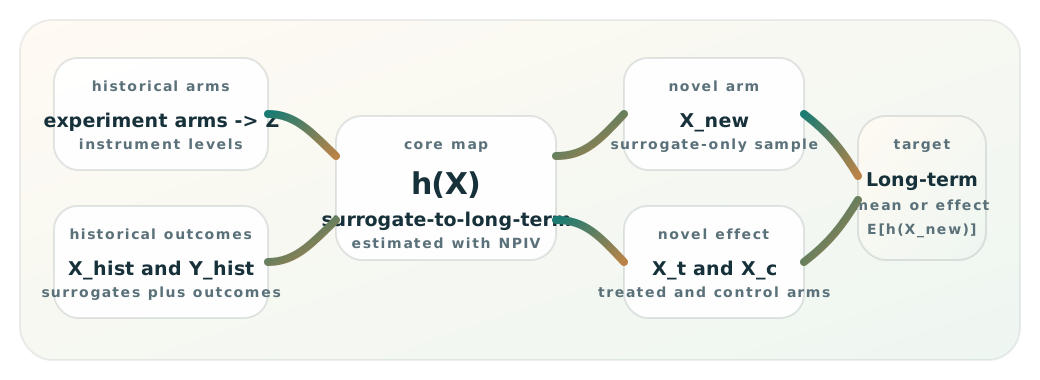
ZX_histY_histX_newencode_experiment_armsestimate_long_term_mean_from_surrogatesestimate_long_term_effect_from_surrogatesEncoding And Diagnostics
Encoding determines the discrete instrument used in the NPIV step. The main distinction is between one historical arm per unit and overlapping historical experiments.
Sparse overlap cells are reported explicitly rather than merged automatically.
Single active arm per row
mode="single" when each historical unit
belongs to exactly one experiment arm.
pricing_test:treatment or pass local arm labels
together with experiment_ids.
control or
treatment without telling the package which
experiment they belong to.
Overlapping historical experiments
mode="overlap" when a historical unit can be
exposed to multiple concurrent experiments.
Illustrative Example
The example below shows the wrapper interface for estimating a long-term treatment effect from historical experiments and a surrogate-only novel experiment.
The full simulated workflow lives in
scripts/reproduce_surrogate_case_study.py.
import numpy as np

from discreteNPIV import estimate_long_term_effect_from_surrogates

rng = np.random.default_rng(12)

historical_experiment_ids = np.repeat(["exp_a", "exp_b", "exp_c"], 80)
historical_arm_labels = np.tile(np.repeat(["control", "treatment"], 40), 3)

arm_shift = {
    "exp_a:control": np.array([0.0, 0.1, -0.1]),
    "exp_a:treatment": np.array([0.4, 0.2, 0.0]),
    "exp_b:control": np.array([-0.1, 0.0, 0.1]),
    "exp_b:treatment": np.array([0.2, 0.3, 0.2]),
    "exp_c:control": np.array([0.1, -0.2, 0.0]),
    "exp_c:treatment": np.array([0.3, 0.1, 0.3]),
}
theta = np.array([0.8, -0.5, 0.4])

surrogates = []
outcomes = []
for experiment_id, arm_label in zip(historical_experiment_ids, historical_arm_labels, strict=True):
    key = f"{experiment_id}:{arm_label}"
    confounder = rng.normal(scale=0.35)
    x = arm_shift[key] + confounder + rng.normal(scale=0.2, size=3)
    y = x @ theta + 0.5 * confounder + rng.normal(scale=0.2)
    surrogates.append(x)
    outcomes.append(y)

X_hist = np.asarray(surrogates)
Y_hist = np.asarray(outcomes)

X_new_control = rng.normal(loc=[0.05, 0.0, 0.0], scale=0.2, size=(500, 3))
X_new_treated = rng.normal(loc=[0.25, 0.15, 0.1], scale=0.2, size=(500, 3))

effect = estimate_long_term_effect_from_surrogates(
    X_hist=X_hist,
    Y_hist=Y_hist,
    historical_arms=historical_arm_labels,
    historical_experiment_ids=historical_experiment_ids,
    X_new_treated=X_new_treated,
    X_new_control=X_new_control,
    n_splits=2,
    random_state=12,
)

print(effect.selected.estimate)
print(effect.selected.ci_lower, effect.selected.ci_upper)
print(effect.selected.method_name)
For a single novel arm, effect.treated_mean.selected
or effect.control_mean.selected gives the estimated
long-term mean.
effect.selected is the estimated long-term
treatment effect with a standard error and confidence interval.
effect.encoding records how the historical
experiments were encoded and whether some categories are sparse.
Assumptions
A causal interpretation requires the historical experiments to generate relevant exogenous variation in surrogates and the novel target to be supported by that historical variation.
The estimator can be computed outside this regime, but the causal interpretation then becomes less credible.
Key assumptions
Practical interpretation
References And Navigation
This page covers the surrogate application layer. The low-level NPIV interface remains on the main package page.
README.md,
docs/long_term_surrogate_case_study.md,
docs/experiment_encoding.md, and
docs/loo_jackknife.md.